
Inside Toyota, Hyundai and M-Sport Ford’s final Rally1 generation — the engineering, compromises and technology behind a season of speed, survival and championship glory
from the roadside, a World Rally Championship car can look almost deceptively familiar.
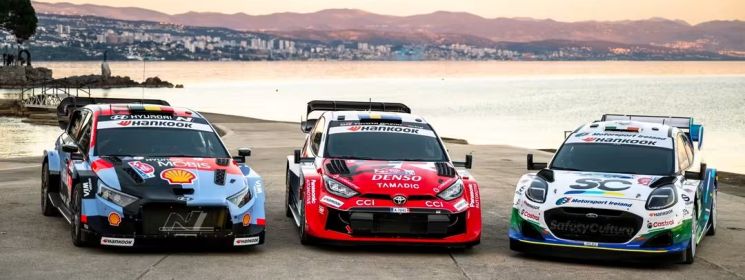
A Toyota GR Yaris.
A Hyundai i20 N.
A Ford Puma.
Three cars that resemble machines a fan might see on a public road but underneath those familiar is an entirely different world, there is a tubular safety structure, a turbocharged 1.6-litre engine, four-wheel drive, competition suspension, racing brakes, specialised differentials, aerodynamic devices and countless components designed not merely to make a car fast, but to keep it functioning when the road itself seems determined to destroy it.
That was the hidden story of the 2026 FIA World Rally Championship.
The season ended earlier than originally planned when Rally Saudi Arabia was removed from the WRC calendar because of regional developments affecting logistical arrangements. Rally Italia Sardegna therefore became the 13th and final round, held from 1–4 October and with Sardinia closing the championship, it also closed the book on the current generation of Rally1 machinery
for the engineers at Toyota Gazoo Racing, Hyundai Motorsport and M-Sport Ford, 2026 was not simply another season. It was the final opportunity to extract everything possible from a generation of cars that had evolved through years of competition.

The FIA introduced the tubular safety cell as a major safety advancement, with the structure designed to reduce accident intrusion while providing a highly rigid foundation for the competition car, that changes the way we should look at these cars.
The GR Yaris Rally1 is not simply a road Yaris made faster.
The i20 N Rally1 is not simply an i20 with a bigger turbo.
And the Puma Rally1 is not simply a road-going Ford converted for rallying. They are purpose-built competition machines wearing familiar identities that distinction matters because when a driver launches a Rally1 car into a corner at high speed, the engineering underneath the bodywork is working just as hard as the driver.
TOYOTA GR YARIS RALLY1: THE MACHINE THAT FINISHED THE JOB
If there was one car that entered 2026 carrying enormous expectations, it was the Toyota GR Yaris Rally1. Toyota had already established the car as one of the defining machines of the Rally1 era, the 2026 version was an evolution rather than a completely new car. Toyota’s engineers used the final-season homologation opportunities to concentrate particularly on areas including aerodynamics and suspension, with a revised rear wing and suspension developments intended to provide greater setup possibilities. That tells us something important about modern rally engineering.
At this level, manufacturers are not necessarily searching for a revolutionary component every weekend.

They are searching for small advantages – a little more stability, confidence under braking, consistency over rough terrain, better traction and perhaps most importantly, a setup that allows the driver to attack without constantly fighting the car. Toyota’s GR Yaris Rally1 uses a 1.6-litre, four-cylinder direct-injection turbocharged engine. With the hybrid system removed from the Rally1 regulations from 2025, the car’s output dropped from the previous hybrid-era levels to more than 370 PS, while the minimum car weight fell to approximately 1,180 kg. The car still uses four-wheel drive, mechanical front and rear differentials and a five-speed gearbox, so while spectators see four wheels attacking gravel, the driver is actually managing a highly integrated system involving engine response, gearing, differential behaviour, suspension movement, tyre grip and aerodynamics.
And this is where Toyota’s greatest strength became particularly interesting in 2026
adaptability with different drivers brought different styles, ages, levels of experience and expectations, yet the same basic machine had to serve them all, that is not just a driver’s challenge, it is an engineering challenge.
THE SUSPENSION: WHERE THE ROAD MEETS THE CAR
If there is one part of a rally car that deserves more attention from fans, it is the suspension because rallying is not conducted on a predictable racing circuit, a circuit engineer can work with relatively known surfaces while a rally engineer cannot. One kilometre can be smooth, the next can contain deep ruts, rocks, jumps, compressions then a section where the car must change direction at enormous speed.
The suspension therefore has two apparently contradictory jobs: absorb the road and control the car, too soft or stiff and the car can become unstable and the tyres may struggle to maintain contact with the surface. This is why suspension setup becomes a continuous compromise between grip, stability, impact absorption and driver confidence, Toyota specifically identified suspension as one of the areas targeted for development for its final-season GR Yaris Rally1.
And that is perhaps the easiest way for a fan to understand engineering in WRC, the fastest car is not necessarily the car with the most power. It is the car that allows its driver to use the available performance for the greatest amount of time.

HYUNDAI i20 N RALLY1: ENGINEERING AROUND THE UNKNOWN
The Korean manufacturer entered 2026 with a refreshed structure and a clear ambition to fight for the championships, fielding three i20 N Rally1 cars with its third entry rotating among crews according to expertise and experience.
The i20 N Rally1 demonstrates another important principle of rally engineering:
versatility. A WRC car has to survive environments that could not be more different.
Snow and ice, fast asphalt, loose gravel, heat, dust, mud, rocks and events where the surface changes dramatically from one stage to another. Hyundai’s technical specification gives us a fascinating glimpse underneath the bodywork.
The i20 N Rally1 uses a reinforced steel structure with a welded multi-point roll cage and composite bodywork. It is powered by a 1.6-litre turbocharged four-cylinder engine, uses four-wheel drive and a five-speed manual transmission, while adjustable MacPherson suspension is used front and rear. The specification lists approximately 360 hp and 450 Nm, with a minimum vehicle weight of 1,180 kg and 1,350 kg with driver and co-driver, even the brakes change according to the surface.
WHY A RALLY CAR CAN NEVER BE “PERFECT”
This is one of the most interesting stories that fans rarely hear, there is no perfect rally setup.
There is only the best compromise for the road ahead. On gravel, engineers are looking for traction and controlled suspension movement.
On asphalt, they can chase sharper response and stronger braking performance.
In rough rallies, durability becomes increasingly important. On high-speed stages, aerodynamic stability becomes more significant and then there is the tyre. The tyre is the only part of the car actually touching the road, everything else — engine, gearbox, suspension, differential, brakes and aerodynamics is ultimately trying to make those four contact patches work.
This is why tyre management can become a decisive part of rally strategy. Cuts, punctures, overheating and degradation can destroy a perfect engineering package in seconds.
THE SMALL THINGS THAT CAN END A BIG RALLY
Perhaps the most fascinating part of WRC engineering is that the component that ends a rally does not always have to be spectacular.
It can be a damaged radiator, a puncture, broken suspension component, damaged cooling system, a sensor, a gearbox problem or a component affected by vibration. That is why reliability engineering is so important, engineers must create a car reliable enough for the driver to concentrate on driving rather than constantly worrying about mechanical survival.
But drivers and co-drivers still have responsibilities of cleaning radiators, checking air filters, managing tyres, monitoring the condition of the car, making quick decisions when something goes wrong, the relationship is therefore not: driver versus machine.
It is: driver + co-driver + engineers + mechanics + machine.
M-SPORT FORD PUMA RALLY1: THE OTHER SIDE OF THE BATTLE
Then there was M-Sport Ford.
The Puma Rally1 may not have received the same championship headlines as Toyota’s machine, but that does not make its engineering story less important. In fact, M-Sport’s position makes the Puma one of the most interesting cars to examine.
The team has operated at the sharp end of WRC with a very different scale of resources from the major factory operations. Yet the Puma has continued to compete against Toyota and Hyundai on some of the most punishing roads in international motorsport.
And that makes the M-Sport story about more than outright speed.
It is about engineering efficiency, development, reliability and extracting performance from a finite package.
The Puma became part of a fascinating driver story in 2026 as well, with younger crews such as Joshua McErlean and other drivers gaining experience at the highest level.
For them, the Rally1 car was not simply transportation. It was a teacher, every braking point, gear change, corner, jump, mistake, mechanical problem and successful stage.
The car was effectively giving the driver information.
THREE MANUFACTURERS — THREE APPROACHES — ONE OBJECTIVE
Toyota.
Hyundai.
M-Sport Ford.
Their philosophies, resources and development paths are different but the objective is identical:
make the driver faster without making the car impossible to control, that requires a balance between: engine performance, transmission, four-wheel-drive behaviour, differential settings, suspension, brakes, tyres, aerodynamics, cooling, weight, durability, safety and driver confidence. None of these systems operates independently, change one thing and something else can change with it.
Make the suspension softer and you may gain traction but alter stability, change aerodynamic balance and you change how the car behaves at speed, alter gearing and you change how the engine delivers its performance. Reduce weight and you may improve agility, but durability and component strength remain essential.
This is why modern rally engineering is less about finding one magic component and more about making thousands of decisions work together.
THE HUMAN VARIABLE: SAME CAR, DIFFERENT DRIVER
Perhaps the most beautiful part of the 2026 season was watching different generations and nationalities extract different things from these machines.
A rally car doesn’t drive itself.
The engineer can design the suspension.
The mechanic can prepare the car.
The software and data can tell the team what happened.
But ultimately, someone has to take the steering wheel into the forest.
That is where engineering meets human instinct. A driver may prefer a car that rotates aggressively, another may want greater stability, one driver may be comfortable carrying huge speed into a corner and another may build confidence progressively. The engineers therefore listen to the driver reports what the car is doing.
Data confirms—or sometimes challenges—that feedback.
The engineers make changes.
The driver tests them.
The process repeats.
That conversation continues throughout a rally season and that is why two drivers can sit in essentially the same car and produce very different performances.
The WRC does not provide engineers with a controlled laboratory.
The laboratory is Greece, Kenya, Finland, Japan, Croatia, Portugal, Sardinia and every other stage on the calendar. The road changes, temperature, grip, weather, tyres, the driver’s confidence changes also and sometimes the road itself changes during the rally, that is what makes rally engineering unique. A Formula 1 engineer can spend an entire weekend refining a car for a single circuit but a rally engineer can spend the same weekend preparing for multiple stages with completely different characteristics.
Rally Italia Sardegna was not just where the 2026 championship ended. It became the final examination for this generation of Rally1 cars.
The cars had travelled through the entire season carrying the accumulated work of thousands of hours in workshops, factories, simulators, testing programmes and service parks.
By Sardinia, there were no more opportunities to save the season for the current generation.
Every lesson from the opening round had to count every development, setup change, mechanical decision, driver comment, engineering compromise all of it came together and ultimately, Toyota’s GR Yaris Rally1 carried Elfyn Evans and Scott Martin to the 2026 drivers’ and co-drivers’ championships.
But reducing the season to one champion would miss the bigger story because the championship was built over the entire season, not created in Sardinia.

THE MACHINE BEHIND THE CHAMPION
When fans see Evans celebrating, Solberg fighting for points, Hyundai crews pushing through difficult stages or M-Sport drivers attacking a gravel road, they naturally focus on the people but behind every one of those moments was a machine that had to survive, a machine engineered to take punishment that had to generate speed without destroying its tyres to absorb jumps without losing control but to protect its crew when things went wrong and a machine that had to do all of this repeatedly, across an entire championship.
That is why the 2026 Rally1 cars deserve to be remembered, not simply as Toyota, Hyundai and Ford-branded rally cars but as the final representatives of a technical era.
THE END OF AN ERA AND THE START OF ANOTHER
The significance of 2026 goes beyond the championship trophies.
It was the final season of the current Rally1 technical regulations. From 2027, WRC enters the WRC27 era. The philosophy changes toward greater affordability, accessibility and flexibility, while maintaining the performance expected from the world’s premier rally championship. The new generation will introduce a different technical philosophy, including a tubular-frame architecture and a suspension concept based around double wishbones, while the regulations permit different approaches to powertrain development over time.
So when the next generation of cars arrives, fans will see new shapes, bodywork, technical solutions, engineering philosophies but they should remember what came before.
The Toyota GR Yaris Rally1.
The Hyundai i20 N Rally1.
The Ford Puma Rally1.
These were not merely cars that appeared on television every weekend, they were engineering projects that evolved through competition carried drivers from different countries, generations and backgrounds. They produced victories, disappointment, broke hearts, created heroes, survived roads that looked almost impossible for a car to survive and ultimately, they gave the 2026 World Rally Championship its identity.

Next season, when a new Rally1 machine rolls out of a service park, fans will probably look first at the livery, wing, wheels and driver.
But perhaps the better questions will be:
1. What has changed underneath?
2. Why is the suspension designed that way?
3. Why does the car sit differently?
4. Why has the aerodynamic package changed?
5. Why does the engine behave differently?
6. What compromise did the engineers make?
7. What problem are they trying to solve?
Because that is where the real story of rallying lives not only in the noise of the engine, but in the engineering decisions that allow that engine to survive the stage.

And that is the greatest lesson from the final Rally1 season: A World Rally Championship car is not built simply to be fast. It is built to make speed possible again, and again, and again on roads that were never designed for racing.
The machines changed. The drivers changed. The rallies changed. But the engineering battle never stopped and now, after Sardinia, the next question is no longer which car will win?
It is: What will the next generation of rally engineering look like?