
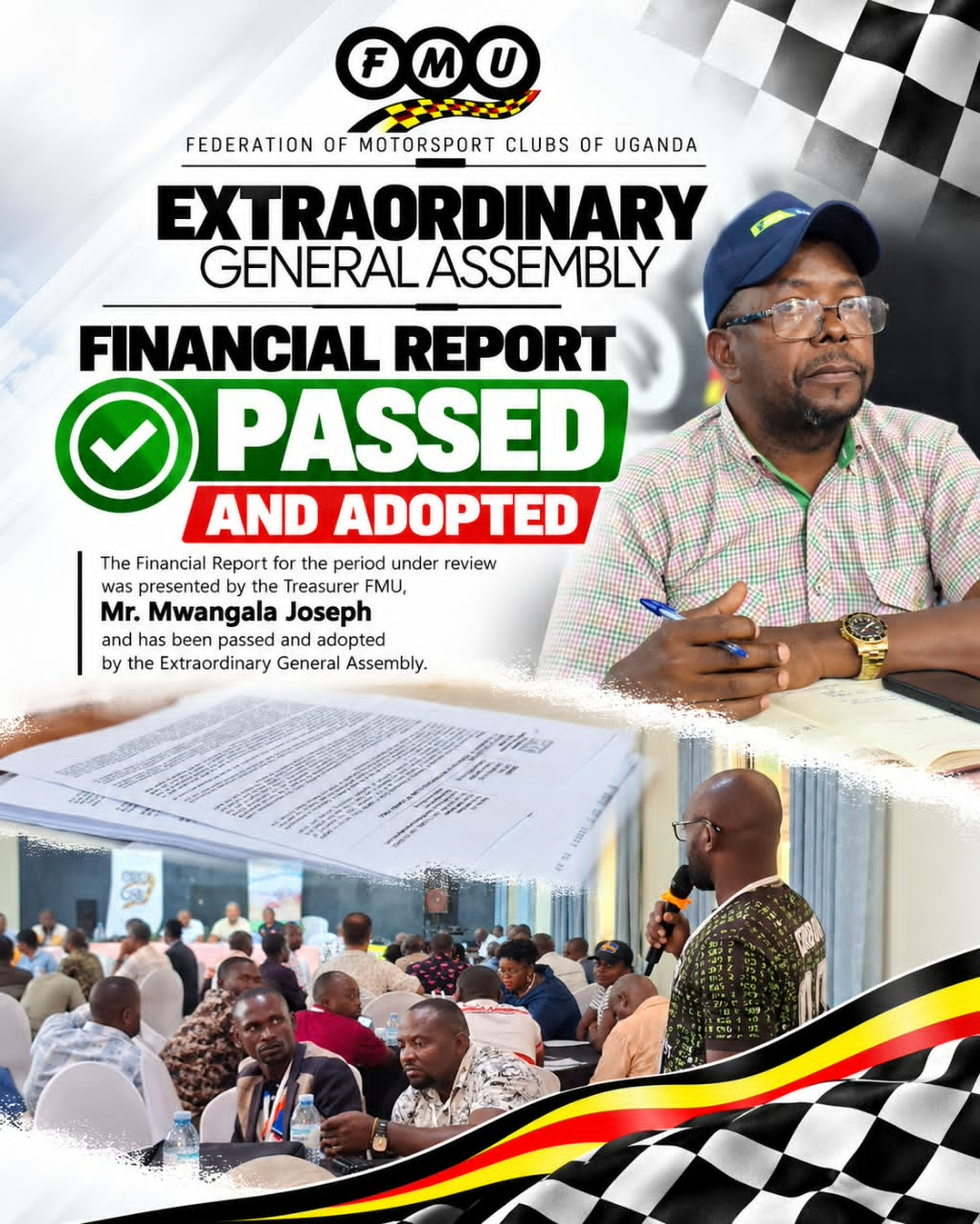
The Federation of Motorsport Clubs of Uganda(FMU) has adopted an amended Constitution at an Extraordinary General Meeting (EGM) held at Kati Kati, Lugogo, in a move aimed at strengthening the governance of motorsport and aligning the Federation with Uganda’s new sports regulatory framework.
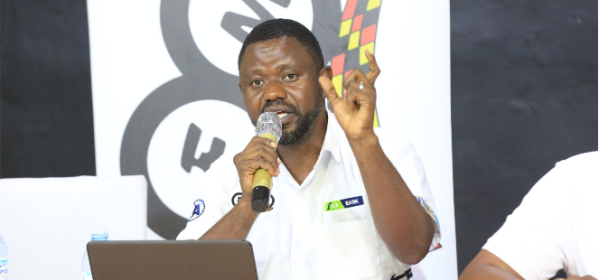
The EGM brought together a broad representation of motorsport stakeholders, including clubs representatives, competitors representatives and delegates from different parts of the country, with FMU General Secretary Reynolds Kibira putting the attendance of more than 139 delegates, well above the constitutional quorum.
For FMU, however, the significance of the meeting went beyond numbers, it represented the culmination of a process that followed the adoption of an earlier Constitution in June 2025 and subsequent consultations with clubs, stakeholders and the National Council of Sports (NCS).
At the centre of those discussions was the need to ensure that the Constitution adequately represented the people and clubs through which Ugandan motorsport operates.
From constitutional concerns to a new framework
Counsel Gimei Abass Godfrey, Chairperson of the FMU Legal and Disciplinary Commission, explained that the latest Constitution was the product of several consultations following concerns raised about the previous framework.
“The journey to where we are today started some time ago and culminated in the adoption of the Constitution in June 2025, that Constitution was passed to enable the Federation of Motorsport Clubs of Uganda to comply with the statutory provisions of the new National Sports Act.” Gimei said.
However, Gimei said the implementation process exposed gaps in stakeholder representation, particularly concerning clubs. “It was discovered that there were concerns regarding how stakeholders, particularly clubs, had been provided for in that Constitution. The sport exists through clubs; without clubs, there would be no sport.” Those concerns subsequently triggered further engagements between FMU, its stakeholders and the National Council of Sports, which Gimei described as the Federation’s regulator.
“Those consultations eventually gave birth to today’s General Assembly,” he said. According to Gimei, the Constitution adopted at the EGM now seeks to address those concerns by providing for the different constituent members within the Federation.
“The Constitution adopted today has taken into consideration the concerns raised by the different stakeholders. It provides a platform where every constituent member is properly catered for under the new dispensation,” he said.
Gimei also pointed to the significance of the Federation’s engagement with the National Council of Sports. “Having gone through the necessary engagement with the National Council of Sports, the Constitution has now met the statutory prerequisites required for FMU to qualify as a recognised federation in Uganda,” he said.
He added that the NCS had informed stakeholders that FMU had attained the required threshold for the issuance of a certificate as a federation.
“Going forward, Uganda now has a full-fledged Federation of Motorsport. Today’s event is therefore a reason for all stakeholders to celebrate this milestone.”
More than 139 delegates and a wider national representation
For General Secretary Reynolds Kibira, the scale and diversity of representation at the EGM was one of the clearest indications of the importance stakeholders attached to the process. “We had more than 139 delegates, and they came from all corners of the country Northern, Eastern, Southern, Central and Western Uganda,” Kibira said.
“We were well above the constitutional quorum, and for me, this is the biggest assembly we have had.” Kibira admitted that there had been some uncertainty over how open and constructive the assembly would be, but said the discussions exceeded expectations.
“I was a bit worried about how open the assembly would be, but we have been amazed by the level of discourse inside the house and the positivity of the delegates towards the future of the sport,” he said.
He described the amended Constitution as historic, particularly because of the changes it introduces to stakeholder participation and governance. The amended Constitution is historic. It introduces important changes, including giving clubs greater representation and the power to elect their delegates. The Constitution also introduces district committees in line with the requirements of the new sports framework.
Kibira further outlined a governance structure that he believes gives FMU a distinctive framework for managing the sport. “We have the Assembly, the Board, the Executive and the Secretariat, while the Business Forum will serve as an intelligence-gathering platform to provide information and feedback to the Federation. The Business Forum will not make decisions or vote but will provide a channel through which information from the wider motorsport community can reach the Federation’s leadership.
“It does not make decisions or vote, but it will help ensure that the sport has intelligence from the wider motorsport community,” Kibira said. He also described the structure as different from conventional corporate governance models but potentially significant for the future administration of the sport.
“For me, this is one of the most important things we have done in the history of the sport,” he said.
Kibira also welcomed the participation of the National Council of Sports at the EGM, describing its involvement as an important part of the Federation’s move towards regulatory alignment. “We are now on the right trajectory,” he said. “I call upon everyone to come on board, support the new system, and let us see how far we can take the sport.”
Competitors want a voice in governance
While the Federation leadership focused on governance and statutory alignment, active competitors at the EGM also used the process to push for greater representation in decision-making. Rally driver and Southern Motor Club Treasurer Dr. Godfrey Nsereko attended the General Assembly as a representative of his club and said the meeting provided an opportunity for competitors to seek clarification on the new Constitution.
“As a member of Southern Motor Club, I was able to attend the General Assembly, and I think we have been steadfast with the agenda items. We are on a good trajectory towards achieving the objectives of the meeting,” Nsereko said.
He said Southern Motor Club had raised questions around the inclusivity of members and active competitors. “As a club, we were seeking clarification around the new Constitution, particularly on the inclusivity of members and competitors like myself,” he said.
Nsereko said some of the concerns had been addressed during the meeting, while proposals for amendments had also been submitted for consideration. “We hope the review commission will do its due diligence to ensure that we have an all-inclusive Constitution at the end of the process,” he said.
For Nsereko, one of the most noticeable developments was the growing participation of active competitors in FMU governance.
“As competitors, we now have a good number of active competitors in the room. If I compare this with an AGM about eight years ago, it wasn’t the same,” he said. The involvement of active competitors in the administration and governance affairs of the Federation has increased and improved, he believes that greater competitor participation could help the Federation address issues affecting those directly involved in competition.
“Issues affecting competition, including competitors’ welfare and representation, are important,” Nsereko said. From where we are going with this Constitution, we are seeing more competitors being brought into the process. I think we are moving positively.
Regional voices join the conversation
The EGM also brought together delegates from outside the traditional centres of Ugandan motorsport, giving regional representatives an opportunity to participate directly in the Federation’s constitutional process. Inka Mutarami, representing the West Nile region, said attending the General Assembly changed his understanding of motorsport from something he had mainly encountered through stories into an experience he could engage with directly.
“Today’s General Assembly has given me a great opportunity to learn more about motorsport. It is something we have mostly heard about through stories, but today I have experienced the reality and learned a lot,” Mutarami said. He described the approval of the Constitution as an important opportunity to participate in the development of the sport, starting with the mandate to approve the new motorsport Constitution, I believe it is a great opportunity for us to be part and parcel of this amendment process.
Mutarami also linked the changes within motorsport governance to the broader implementation of Uganda’s new sports law.
“The meeting has also given me the opportunity to see that Uganda’s new sports law has come into effect and is being implemented,” he said. It is opening up a wider understanding of different sports, and I believe this is going to benefit our people in one way or another.
More than a Constitution
The EGM therefore marked more than the passage of a revised governance document, for FMU, it was an opportunity to bring together the regulator, clubs, competitors and regional representatives around a common framework for the future administration of motorsport.
For clubs, the process has created an opportunity to seek greater inclusion.
For active competitors, it has opened more space for their voices in governance.
And for regional delegates such as Mutarami, it has provided a closer connection to a sport that continues to expand beyond its traditional centres.
The challenge now shifts from adoption to implementation as FMU begins the transition towards the new governance system and prepares for the electoral process, the effectiveness of the Constitution will ultimately be measured by how well its provisions translate into meaningful representation, accountability and development across Uganda’s motorsport community.
For a sport built around clubs, competitors, officials, volunteers and fans, the message coming out of Kati Kati was clear: the next chapter of Ugandan motorsport will depend not only on what happens on the stages, but also on how the sport is governed away from them.