

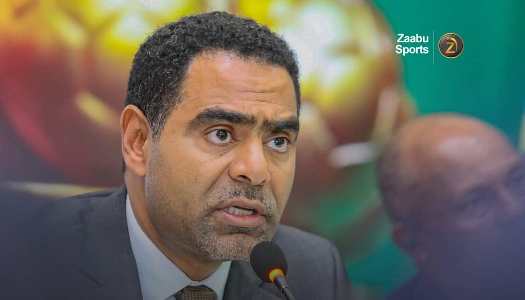
The storm engulfing the Football Kenya Federation has evolved into a defining moment for the country’s sporting future, where questions of corruption, governance, and control now collide with the real danger of international sanctions. At the centre of the crisis is FKF president Hussein Rashid Mohammed, whose suspension over an alleged KSh 42 million insurance deal linked to the African Nations Championship has triggered a deeper institutional confrontation. What initially appeared to be a disciplinary move has since exposed a widening rift that now threatens to draw Kenya into conflict with global football authorities.
The origins of the dispute lie in growing scrutiny over the handling of funds connected to CHAN preparations, where concerns were raised about procurement procedures and financial accountability. The National Executive Committee responded by directing senior officials to step aside to allow investigations, a move framed as necessary to protect the integrity of the federation. Yet the speed and manner of the decision have raised equally serious concerns, transforming what could have been a straightforward accountability process into a contentious struggle over governance itself. The central question has shifted from whether funds were misused to whether the rules of engagement were respected.
Mohammed has forcefully challenged both the allegations and the process that led to his removal, arguing that no financial loss has been demonstrated and that the procedures followed by the Executive Committee were fundamentally flawed. He maintains that he was not granted a fair hearing and that the meeting which produced the resolution did not comply with the federation’s own statutes. His stance has effectively split the leadership structure, creating parallel claims to authority and amplifying uncertainty within Kenyan football at a critical moment.
It is this governance breakdown that has prompted intervention from FIFA and the Confederation of African Football. Their focus has been firmly placed on due process, seeking clarity on whether statutory requirements were met, whether proper procedures were followed, and whether those affected were accorded the right to defend themselves. These considerations go beyond administrative detail and strike at the core of football governance. Failure to meet these standards could place Kenya at risk of sanctions, including suspension from international competition.

There is a long standing understanding in football that the strength of the game depends as much on its governance as on its performance on the pitch. Kenya now stands at a decisive crossroads, where the outcome of this crisis will shape not only leadership within the federation but also the country’s standing in global football. If the dispute proves to be driven more by power struggles than by principled accountability, the consequences may extend far beyond administrative offices and into the very fabric of the sport, with the ultimate cost borne by players, supporters, and the nation’s place in the international game.
Photo: Kamira Asha