

The long-running mystery surrounding the failure of musician Joseph Mayanja, popularly known as Chameleone, to launch his television station has taken a fresh twist, with the project’s consultant rejecting claims that Shs250 million was handed over for a venture that only managed to produce a test signal. In a strongly worded statement dated November 10, 2026, the consultant dismissed the allegations, insisting that no such amount was received and that the station’s failure to go on air was primarily linked to unmet licensing requirements.

According to the consultant, Chameleone first approached the team in 2020 to establish the television station, with preparatory work progressing through several stages before reaching the Uganda Communications Commission (UCC). However, the consultant maintains that the project stalled after Chameleone reportedly failed to satisfy UCC’s requirements, particularly the provision of evidence of sufficient seed capital to demonstrate the financial capacity to establish and sustain a television station. The consultant claims to possess UCC documentation supporting this account and insists that the licensing process could still proceed if the outstanding requirements were fulfilled.
In a direct rebuttal of the Shs250 million allegation, the consultant estimates that Chameleone spent no more than Shs70 million throughout the project. The stated expenditures included Shs10 million for control-room computers, Shs23 million in UCC application and licensing fees, Shs12 million in consultancy fees, Shs17 million for rented encoder and decoder equipment, and Shs4 million for studio and office rent in Makindye. The consultant further claims to hold receipts and bank deposit slips documenting the payments, adding that copies were shared with Daniela Atim through weekly progress reports at Chameleone’s request.
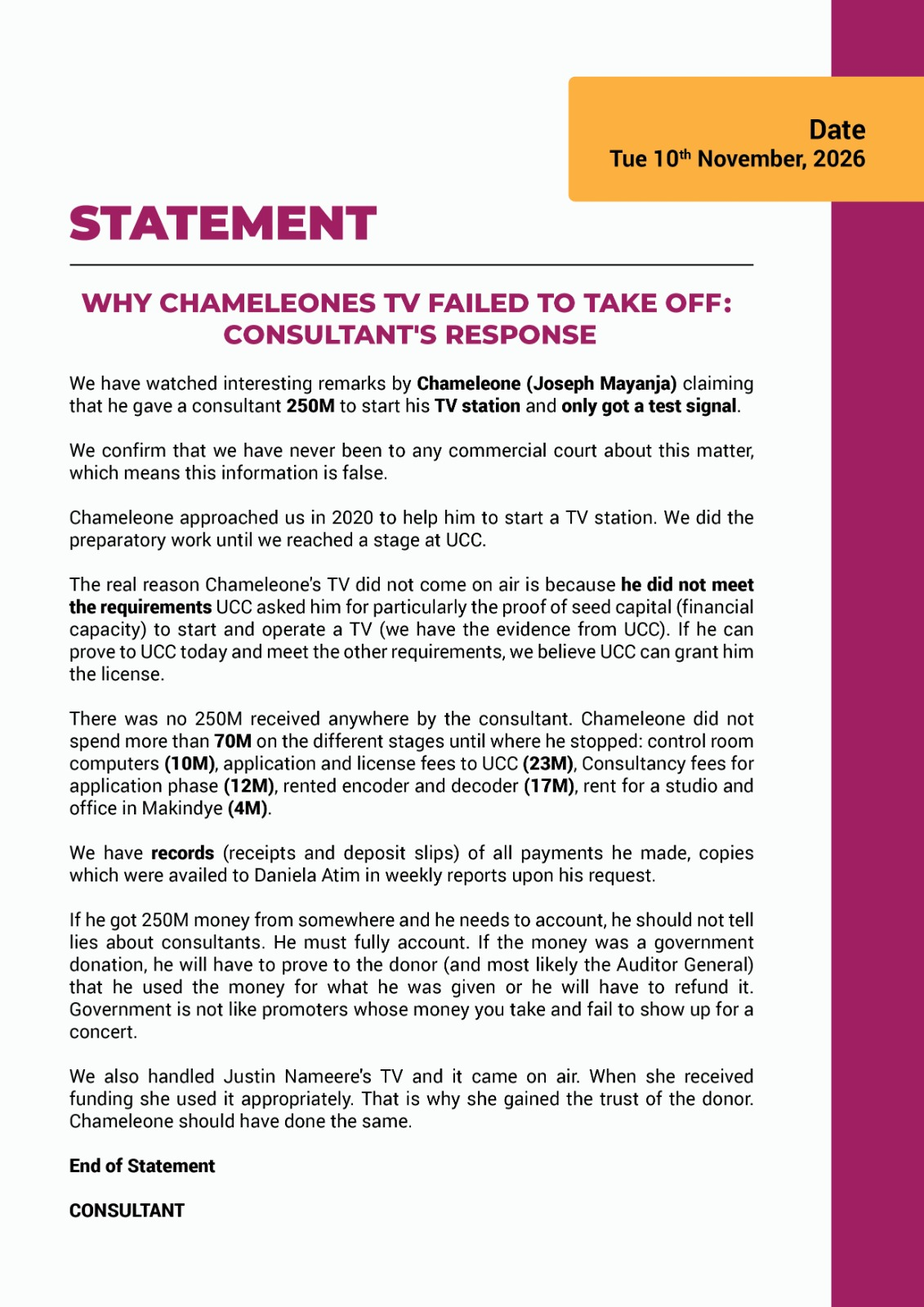
The consultant also challenged Chameleone to account for the alleged Shs250 million, particularly if the money originated from government funding. The statement argues that public funds carry accountability obligations and that any recipient must demonstrate that the money was used for its intended purpose or face the possibility of refunding it. To reinforce its position, the consultancy cited its work on Justin Nameere’s television project, which it says successfully went on air after the appropriate utilisation of donor funding. It also denied ever appearing before a commercial court over the Chameleone matter.
Ultimately, the dispute raises wider questions about financial accountability, project management and the regulatory hurdles involved in establishing a television station in Uganda. While the consultant has presented its version of events and says documentary evidence is available, Chameleone’s response and any independent verification of the competing financial claims remain important to establishing the full picture. For now, the battle over the station’s collapse has shifted from the airwaves to a war of accounts, with the unanswered question being: what really happened to the money behind Chameleone’s television dream?
Courtesy Photo